Augmentation, Not Replacement: Reading the Evidence on AI and White-Collar Work
The headlines say AI is eliminating white-collar jobs. The data says something different. A close read of the evidence from McKinsey, Goldman Sachs, Anthropic, and the Bureau of Labor Statistics.
May 13, 2026
Part 1: The AI replacement story
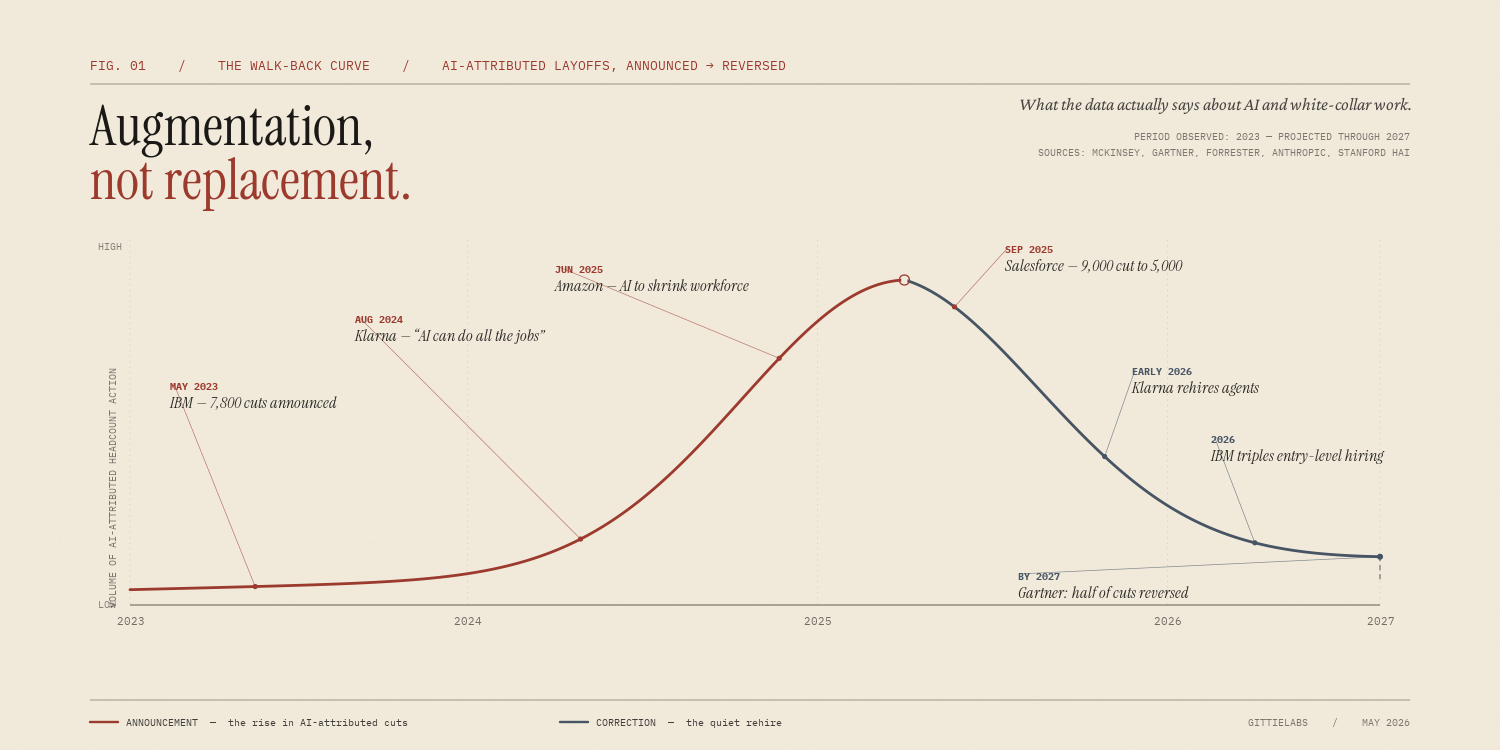
In 2024, Klarna's CEO, Sebastian Siemiatkowski, boasted that he fired 24% of his workforce, roughly 1,200 people. He stated that "AI can already do all of the jobs that we as humans can do..." and that his AI assistants were doing the majority of the work, justifying the elimination of 700 customer service agents. However, less than a year later (mid-2025), Siemiatkowski had to eat some humble pie and told reporters that his company was rehiring humans: "From a brand perspective, a company perspective, I just think it's so critical that you are clear to your customer that there will be always a human if you want."
In May 2023, IBM CEO Arvind Krishna estimated that they would pause or eliminate 7,800 jobs through AI replacements over a 5-year period. In 2026, just 3 years later, IBM is tripling entry-level hiring. The company's talking points now are the importance of human-to-human interaction and their belief that younger workers are AI-native.
In June 2025, Amazon CEO Andy Jassy stated in a memo that AI would shrink the corporate workforce. Later in the same year, he walked it back in their Q3 earnings call, changing the reason for the layoffs as "not really financially driven and not even really AI driven... It's culture."
In September 2025, Salesforce CEO Marc Benioff said that AI's impact would allow him to dramatically reduce headcount. Benioff said, "I've reduced it from 9,000 heads to about 5,000, because I need less heads." Somewhat surprisingly, Salesforce is now hiring 1,000 new graduates to "ride the AI exponential."
So, if we are to buy the story the headlines told us as true, why are the sources now backing off their story?
The rest of this piece argues that the answers matter and that we can examine the data to see this. The major authoritative measures come from Anthropic's own data, McKinsey, Goldman Sachs, and even the Bureau of Labor Statistics. They all point to AI augmentation and not replacement. There are documented cases of effective AI job replacement that are addressed later in this content. Still, the prevailing theme remains: companies that cut headcount before thoroughly testing their AI hypotheses will see trust erode among the workers who survive the cuts, the highest performers leave, and the cost of productivity outweighs the wage savings. Gartner now projects half of the layoffs will be quietly reversed by 2027.
Is this a harsh critique? No, it is a workforce design deficiency. It's the question that senior managers and company directors are in the right seats to address and fix. The defensive option is not "lay off workers now because of a superficial rationalization of what the future holds." No, the right call is to redesign job workflows, measure what AI can actually do, and deliberately shift the workforce composition. The evidence is compelling and matches what the data is telling us.
Part 2: Exposure does not equal replacement
The single statistic most misunderstood comes from McKinsey's "60-70%" stat in their report on the economic potential of generative AI. It's quoted and used everywhere in board decks, on LinkedIn, in the media, and it's consistently framed to mean something it does not.
McKinsey's statement on employee time savings refers to its estimate of how much of today's work time consists of activities that are technically automatable with current generative AI and other technologies. That does not mean half of all jobs would disappear; many would change as specific tasks are automated. McKinsey clearly states that generative AI drives large-scale task automation and worker transition, but they stop short of forecasting aggregate mass net job elimination. Instead, they view AI as augmenting individual workers by automating parts of their job, enabling productivity gains, rather than saying entire roles vanish.
A similar misreading of stats comes from Goldman Sachs' "300 million jobs exposed" figure. "Exposed" does not equal job replacement. It means occupations in which a meaningful share of tasks can be automated with AI. In exposed occupations, Goldman Sachs believes that 25-50% of tasks are automatable. They are not saying the entire role is replaceable. The Eloundou et al. paper "GPTs Are GPTs" finds that about 80% of US workers have tasks that are at least 10% exposed, but only 19% have tasks that are greater than 50% exposed. And in their report, they define "exposed" as tasks AI reduces by more than 50%, which, again, means this is augmentation, not a replacement.
Acemoglu's NBER paper "The Simple Macroeconomics of AI" sets the bar even lower: with total factor productivity gains capped near 0.66% over the next 10 years, which would be a single-digit percentage of tasks.
The most informative and useful data comes from the foundation model providers. Anthropic publishes an Economic Index classifying real conversations on their platform (i.e., they don't use your data but have wonderful "classifications" of what your conversations mean). Their January 2026 report found that 55% of conversations implied augmentation (validation, learning, iteration), and the remaining 45% attributed to automation. They further concluded that inside "automation", the user is still in the loop on most conversation exchanges. If Anthropic's platform usage is telling us an augmentation story, that is compelling.
A plain reading of all the data shown indicates that, for a typical white-collar worker in 2026, AI can meaningfully augment 30-60% of tasks but replace 0-15% of jobs.
I can't paint a complete picture of the augmentation story without mentioning the occupations being disrupted. There are places where AI has crossed the 60% threshold for successfully completing automated tasks. Bank of America developed a financial assistant (Erica) that has grown to handle more than 3 billion client engagements. The Bureau of Labor Statistics projects a 5% decline in customer service representative positions between 2024 and 2034, citing AI and automation. The UK Society of Authors found that more than 33% of translators and a quarter of illustrators have lost their jobs due to AI. Further, 43% of translators have seen their income reduced due to the devaluation of their work. The Stanford HAI 2026 Index concludes that new entry-level software engineer jobs (ages 22-25) are down nearly 20% since 2024.
These are real. They are also exceptions, representing a smaller segment across all occupations and not the rule. The loss is visible, measurable, and the failure mode is recoverable. However, this isn't the case for most knowledge work.
Currently, workforce exposure is unevenly distributed, and we do have areas that are more suited to automation. Still, experiences like Klarna's, which fired first, declared victory, and then ultimately had to reverse, are the more common outcomes.
So why did the cuts even happen to begin with?
Part 3: Why Companies fired anyway: the FOMO economy
This part outlines some uncomfortable evidence but also important insights we can't overlook. It brings into the light a bad look for the people making these decisions.
A late-2025 Resume.org survey of 1,000 US hiring managers — also covered by NJBIA — contains the cleanest single summary of the AI-layoff cycle anyone has put on paper. Only 9% of those managers report that AI has actually replaced roles at their company. Roughly 6 in 10 (59%) admit they cite AI as a layoff reason because it plays better with shareholders and the public than admitting cost pressure or weak performance.
A majority of AI-blaming is explicit framing.
The supporting evidence stacks up. A January 2026 Harvard Business Review piece by Davenport and Srinivasan reports on a survey of 1,006 global executives in which more than 600 said they had made layoffs in anticipation of what AI might do, not based on AI's current performance (the HBR article itself sits behind a subscription wall; the headline finding is also reported in Tom's Hardware).
According to Forrester's January 2026 predictions (summarized in TechCrunch), many companies making AI-related layoff announcements do not have AI in place with the capabilities to replace them. Built In has documented the pattern under the label "AI-washing."
A review of companies testing with AI pilot programs also reveals unflattering results. MIT's NANDA project, in its State of AI in Business 2025 report, found that despite spending $30-40 billion, 95% of enterprise GenAI initiatives show a zero P&L return. S&P Global Market Intelligence's 2025 Voice of the Enterprise AI/ML survey (the underlying report is paywalled, but CIO Dive's coverage is open) found that 42% of AI projects were abandoned before reaching production, which is up 17% from last year. RAND's "Root Causes of AI Project Failure" report shows very high estimates of project failure, stating that 80% of AI pilots failed, which is 2x the failure rate of other non-AI corporate IT projects. McKinsey's State of AI 2025 finds that 80% of organizations report not yet seeing any real enterprise-level EBIT impact from AI investments.
We could reasonably conclude that companies announcing AI-driven cuts are mainly part of the same population that is failing to deploy any AI-related technology to production. And this would imply that their headcount cuts are running ahead of their current capability to actually use AI, which is counterintuitive to slashing jobs because of AI.
If AI-washing is real and we all see it, then why do it? Stanford's Jeffrey Pfeffer, who has spent a career on this type of question, has a very direct explanation. Tech layoffs, from his 2022 Stanford GSB analysis, are "social contagion... imitative behavior, not particularly evidence-based," which he simplifies as "copycat behavior." Companies cut jobs because their peers do. More surprising is that these companies were seemingly rewarded for their layoffs. Money.com summarized Bloomberg's analysis, which found that, on average, large US tech companies saw their stocks rise 5.6% in the month following their job-cut announcements.
OpenAI's Sam Altman has also publicly said that almost all companies laying off workers are blaming AI, whether or not their reasons are actually AI-related.
Challenger Gray & Christmas's 2025 year-end report — the only systematic public source that codes AI as a stated layoff reason — found that AI was cited in 54,836 cuts out of 1,206,374 total in 2025, about 4.5%. The share then spiked: Challenger's April 2026 monthly report found AI cited in roughly 16% of cuts year-to-date. Total layoffs, meanwhile, are at the highest level since 2020. The macro story is cost-cutting in a softening labor market; AI is the framing.
I am not saying that AI isn't a reason for job cuts or that no jobs have been replaced. However, if you look at our current layoff numbers in aggregate, it's hard to buy the story we are told. This AI wave of layoffs mimics copycat behavior, attempting to correct for miscalculations in hiring and economic change, hurting their profits.
For board directors, this is your opportunity to challenge the narrative your executive team has passed down to you. When the CEO presents an AI-driven workplace plan, you don't have to assume the plan is solid. You need to question the plan: "Show me the production deployment, provide how you measured the productivity per replaceable task, and how you validated the workflow change that backs a headcount reduction." If there aren't documented plans and readily available results, you are likely being asked to sign off on the company's framing rather than its real strategy for the reasons behind company reorgs that include layoffs.
Part 4: The survivor cost: Firing can be worse than doing nothing
Layoffs done wrong carry a cost evident in the people who remain. It shows up first in their output after their colleagues leave, then in their voluntary attrition, and finally in lost productivity, which runs counter to the company's objectives.
Joel Brockner's research at Columbia Business School outlines a relationship between job insecurity and survivor work effort. A moderate level of insecurity tends to increase worker output, while severe insecurity causes worker effort to collapse entirely. Yes, you may see output increase temporarily after layoffs, but quality degrades alongside it. This effect is especially pronounced when survivors don't perceive layoffs as justified.
The survivor statistics you should know — most from Leadership IQ's repeated surveys — are unambiguous. 74% of survivors report their own productivity declined; 77% see more errors and mistakes; 69% say their company's product or service quality declined. 65% report making costly mistakes after being asked to absorb colleagues' work without training, and 45% plan to leave within a year without that training.
Cornell ILR's Charlie Trevor and colleagues tracked thousands of workers over decades and found that employees who've been laid off are much more likely to quit their later jobs, including with new employers. In one summary of their results, workers were about 65% more likely to quit their jobs immediately following a layoff than they were to quit their pre-layoff jobs.
Research summarized by the LSE Business Review finds that layoffs trigger the largest spike in subsequent turnover, and that when a high performer quits, turnover rates for other high performers rise by about 6% per month — a cumulative 18% — over the following three months.
Wayne Cascio's research on employment downsizing, which includes a 37-year study of 43,000 New York Stock Exchange companies, finds that firms that rush to layoffs tend to see weaker financial returns. The study also concludes that downsizers, as a group, do not outperform comparable firms that avoid layoffs. Simple headcount cuts rarely deliver the long-term results leaders expect. And as Sandra Sucher and Shalene Gupta's work on trust at Harvard Business School shows, any short-term savings are often swamped by severance and rehiring costs, loss of institutional knowledge, lower morale and engagement, higher turnover, and weaker innovation, which ultimately damage profits and weaken trust in the company.
Most of this is true of any layoff cycle. What is different about the AI-attributed way is the false context pushed of how this single disruptive technology is supposedly going to render all workers useless.
ManpowerGroup's 2026 Global Talent Barometer report details that 43% of employees are concerned automation may replace their jobs within 2 years. They further state that 56% of surviving employees have received no recent training on using AI in their work. At the same time, Gallup reports U.S. employee engagement at a 10-year low, with only 31% engaged, and Microsoft's 2025 Work Trend Index shows that 68% of employees are struggling with the pace and volume of work, with nearly half (46%) experiencing burnout.
The CHI 2025 study on laid-off tech workers calls out "the cruel optimism of tech work," defined as a strong emotional attachment to tech work and its promises. Mass layoffs are causing workers to become disillusioned and lose trust in the industry. Additionally, this unjustified attachment creates morale issues, and their best workers start to quietly disengage from their companies. They begin to imagine futures elsewhere, rather than mounting visible resistance.
The connection to using AI as the scapegoat could be creating death spirals within these companies. We can see the stages unfold: visible AI-attributed cut in the media → forcing survivors to adopt AI as an ultimatum → triggering a trust collapse → and then a temporary productivity spike from fear, followed by quality decline in their work → moving to high-performers quitting → and ultimately ending with the net effect of productivity erosion. Each stage is independently documented. The AI overlay multiplies the effects of the older survivor-syndrome story.
A workforce reduction plan that fails to account for the steep costs of action is not a winning bet. It is a cost forecast that omits its largest line item.
Part 5: The reversal cycle is already underway
The walk-backs in the opening were not isolated. They are the visible artifacts of a documented pattern.
Klarna's original "700 FTE" proved to be a fallacy; AI didn't get it right on its own. The CEO did an about-face and now positions the company as human-centered, leveraging AI to deliver what customers most need. Klarna is rehiring customer service agents to address a considerable drop in customer satisfaction.
IBM has tripled entry-level hiring for 2026, and the company's new viewpoint is that AI can handle most entry-level work, but it still requires a human touch. The staff reduction forecast was never realized. In reality, the actual displacement was several hundred HR roles, and the total IBM headcount has grown.
Amazon's change of heart on the earnings call is on record. Duolingo dropped its AI-usage performance metric from employee evaluations after employee pushback (Fast Company coverage). Salesforce — which cut 4,000 customer-service roles in late 2025 and continued trimming through early 2026 — is now hiring 1,000 new grads. Benioff is publicly saying that AI won't kill entry-level jobs.
Gartner predicts that by 2027, half of the companies using AI as a reason for layoffs will rehire to perform similar functions under different job titles. Forrester echoes the same prediction of reversals, stating "that over half of layoffs attributed to AI will be quietly reversed". These are not advocacy organizations. They are the analyst houses whose customers are the same CFOs and CIOs who made the cuts.
The capital markets are starting to change their tune on rewarding AI layoffs. Goldman Sachs equity research in December 2025 (as summarized in Fortune and externally) found that investors are increasingly punishing layoff-announcing stocks rather than rewarding them. Cloudflare fell 23% on the day of its AI-framed cuts in May 2026.
For a director or senior manager, the takeaway is that the AI layoff cycle has a knowable trajectory, and boards that move ahead of it will outperform those still focused on announcements.
Part 6: Edge cases: where AI has actually replaced work
It would not be fair to omit elements that provide a counterargument that has true merit worth discussing. There are areas where AI has changed the landscape and displaced workers.
The strongest case for worker displacement is Tier-1 customer support. This work is defined as being high-volume, transactional, and well-defined queries applicable to commerce, fintech, Saas, and many other industries with direct customer engagement. And while customer service work is not completely automatable, AI has proven very capable of handling the load of scoped support issues.
Intercom's Fin now averages about a 67% AI resolution rate across its customer base and handles over 2 million conversations per week. Decagon reports 65-70% ticket deflection at Whop and an increase from 38% to over 50% chat deflection at Rippling. Sierra's WeightWatchers deployment resolves nearly 70% of customer cases, keeping customer satisfaction over 4.5 out of 5. Bank of America's Erica has been in production since 2018, has surpassed 2 billion client communications, and now handles about 2 million interactions per day. IBM's AskHR automation now handles around 94% of routine HR tasks and has enabled IBM to automate the work of a few hundred HR roles, adding to a wider HR transformation effort.
The translation case is the strongest independent macro data point. The UK Society of Authors 2024 survey found that 36% of translators have lost work to generative AI, 43% have seen income drops.
AI coding agents are attracting a lot of attention for their ability to generate code faster than humans on tasks routinely assigned to junior developers. Experienced developers were observed using coding agents to work on open-source projects to see if their productivity would increase. Developers using AI completed 55.8% of tasks faster than their counterparts who did not use AI. A larger study involving Microsoft and Accenture estimates that adopting Copilot increases weekly pull requests by roughly 21-26% on average, with less-experienced developers benefiting the most.
Google CEO Sundar Pichai reported that about 25% of new code was generated by AI in late 2024, and by late 2025, that number increased to 50%. He also estimates that by spring 2026, it will reach 75%, explicitly noting that this code is still under review and approval by engineers rather than being shipped untouched. In other words, "AI-generated" in these statements refers to code initially produced by AI and then reviewed by humans, not autonomous deployment.
METR's 2025 study on AI's effects on experienced dev productivity offers a different viewpoint. The experiment shows AI tools actually slowed productivity on average by 19%. Before starting work, the participants estimated that AI would help them be roughly 24% faster. When asked later, the participants reported being 20% more productive. This shows a large gap between perceived and actual performance. AI can reduce throughput while making users feel more productive. AI also reliably speeds up many structured or novice-heavy tasks, but coding agents often add cognitive overhead and integration costs that hurt efficiency. These effects occur alongside a broader trend: AI is increasing the share of machine-written code and compressing the traditional junior-to-senior apprenticeship pipeline.
These are examples of where AI is impacting roles. I could argue that the defensible position is that transactional Tier-1 support, routine translation, and entry-level coding are now doing enough of the work that hiring patterns and freelance markets have visibly contracted. Anyone arguing more than that is arguing past the data.
Part 7: What to do instead: a blueprint for executives and board members
If predictive cuts now are the wrong move to make, what is the right one?
Companies are adopting AI, but only a small minority are seeing a material bottom-line impact. The ones benefiting the most are redesigning work rather than sprinkling tools on top. McKinsey states in their 2025 State of AI survey that "meaningful enterprise-wide bottom-line impact from the use of AI continues to be rare." Only a small set of AI high performers report that AI contributes at least 5% of their EBIT. Roughly half of high performers report redesigning workflows, compared with about one-fifth of other companies. In other words, the firms actually moving the EBIT needle are the ones willing to re-engineer how work gets done around AI, not just bolt on chatbots onto legacy processes.
Boston Consulting Group's AI at Work 2025 report shows a similar pattern at the employee level. In BCG's global survey of more than 10,600 workers, 72 percent say they use AI regularly, meaning several times a week or more, yet the press release accompanying the report stresses that "the true value of AI is being captured by a smaller subset of companies that go beyond tool deployment to fully redesign workflows." BCG believes moving from adoption to impact occurs when we understand how people and machines collaborate. Companies committed to a comprehensive redesign of job functions, investing in training, tracking value, and deliberately reshaping their workflows, will be able to achieve productivity gains. Taken together, the McKinsey and BCG data suggest that the main separator is not whether employees have access to AI tools — most already do — but whether leaders are prepared to drive end-to-end workflow redesign and broader work reinvention around those tools.
The implication is the framework. Here are the four moves to implement.
-
Measure before you cut. The gold-standard template here is Brynjolfsson, Li, and Raymond's Generative AI at Work in the Quarterly Journal of Economics. They conducted a field study of 5,000+ customer service agents, measured multiple productivity KPIs by skill/experience, and tracked customer satisfaction. Their core finding (AI augments agents, average productivity rises by around 15%, with much larger gains for less experienced agents, and overall NPS remains unchanged) is less important than the method. Before any AI-driven workforce decision, the company should be able to produce an equivalent measurement for the function in question. If the vendor pitch is the only evidence on the table, the company is being asked to fire on faith.
-
Redesign the workflow, then shift the composition. Many large tech firms are redesigning workflows first, then adjusting workforce composition to replace legacy roles and skills. Cisco, for example, describes a workforce strategy that focuses on redesigning work. Their strategy focuses on accelerating training and hiring for AI capabilities. Meta's announced layoffs are tied to a pivot and consolidation around generative AI, illustrating the sequence of reorganizing teams and then changing hiring patterns. AI's largest impact results from reshaping end-to-end workflows, creating new role definitions, and promoting/upskilling dynamics. This route is better than merely automating incumbent jobs, which changes communications, severance approaches, and the signals sent to remaining employees.
-
Protect the bottom. Developing entry-level workers is key to having future leaders. IBM's CHRO says it will triple entry-level hiring because AI augments routine work, but still requires human assessment. In addition, we need to provide entry-level workers opportunities to mature into senior talent.
Stanford HAI's recent payroll analysis indicates a roughly 13% relative decline in employment among 22-25-year-olds in occupations exposed to AI since late 2022. This represents a meaningful reduction in early-career opportunities and could translate into a senior-level talent gap in 3 to 7 years if firms do not rebuild their pipelines.
Firms that are visibly increasing graduate hiring, such as IBM and Salesforce, are treating entry-level programs as a deliberate complement to AI strategy (replacing blunt cost-cuts with purposeful pipeline investment), not a contradiction of adopting AI technologies.
-
Treat trust as the asset it is. Sucher and Gupta's research indicates trust damage is a durable, hard-to-reverse cost. The walk-backs from Klarna, IBM, and Amazon are expensive, not because of the financial reversal but because of what they confirm to the survivors — that the first announcement was a framing, not a fact. The companies that come out of this cycle with their cultures intact will be the ones that did not announce until they could defend the announcement. This is a communications discipline as much as a workforce discipline, and one that the board can require.
These four moves outline the deliberate actions a company facing reorganization should consider. Companies that successfully apply them are currently rare, which explains forward-looking reversal forecasts — Gartner's 50% rehire prediction and Forrester's over 50% regrets.
If companies continue to issue layoff announcements blaming AI without proven capabilities to replace workers, the costs will be borne by survivors, and the company's objectives for the layoffs will not be achieved.
Augmentation, not replacement, is what the data shows AI is doing right. The companies that build their workforce strategy on that finding — rather than on the framing they used to announce last year's cuts — will be the ones whose AI investments actually compound.